AI & Automatisering
A rebuilt Memories page
Doorzoek al je opgeslagen herinneringen en bepaal hoe lang gegenereerde herinneringen in je bibliotheek blijven.

De bodem verschuift. v5.7.0 rebaset de hele fork op de Immich v3.2.2-basis — 378 upstream-commits die onder elk Gallery-oppervlak zijn ingevouwen, de grootste basissprong sinds de overstap op v5.0.0. Het meeste wat daarmee meekomt is zichtbaar: Memories krijgt een herbouwde pagina op het web en, voor het eerst, een eigen lijst op je telefoon — geleverd door de API, dus de via een Space gedeelde herinneringen die de rij erboven al toont staan er ook in. De kaart krijgt een knop „Toon foto’s in dit gebied” die alles waar je naartoe hebt geschoven in een timeline verandert. Workflows houden per uitvoering een log bij dat je kunt openen als een regel niet deed wat je verwachtte, en een tag kan er nu zelf een starten. Wat bewust niet meekomt is het nieuwe groepsdelen van Immich — Shared Spaces doet dat werk al, dus het instellingenscherm ervan wordt verwijderd in plaats van halfaangesloten achtergelaten — en het nieuwe zoeken, waarvan de verzoekvorm op alle vier de verdeelpunten wordt geweigerd omdat er geen shared-space-arm in zit. Het palet blijft het zoeken.
Doorzoek al je opgeslagen herinneringen en bepaal hoe lang gegenereerde herinneringen in je bibliotheek blijven.
Filter kaartpins in realtime op personen, camera, tags en meer – zowel voor de hele bibliotheek als binnen Spaces.

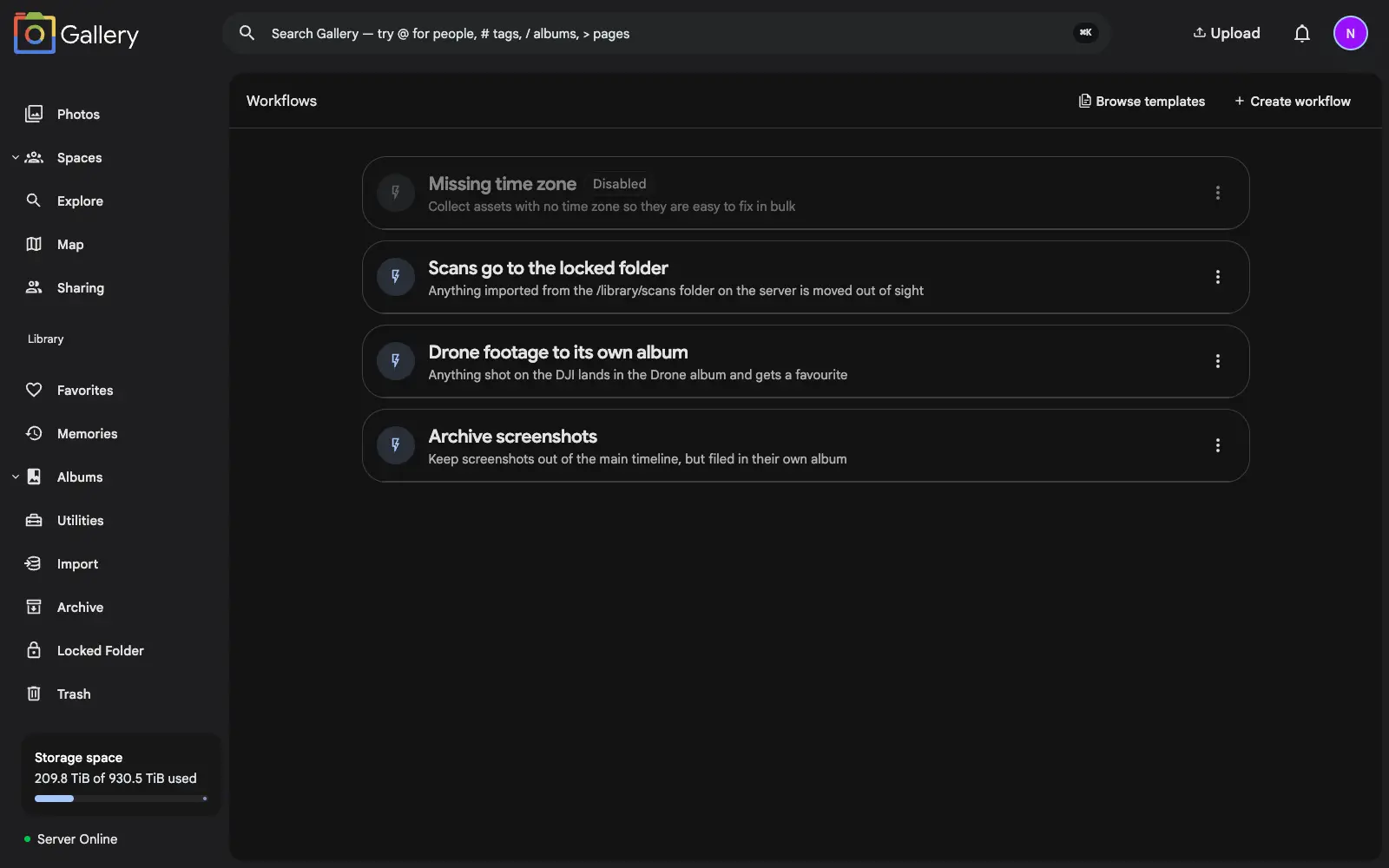
Leer je bibliotheek zichzelf op te ruimen. Bouw regels die meteen werken zodra een foto binnenkomt — screenshots archiveren, drone-opnames in een album, scans achter slot.
Gallery's foundation moves from Immich v3.1.0 to v3.2.2: 378 upstream commits replayed underneath, with the fork's own 1,525 rebased on top of them.
Everything else the new base brings is upstream work, documented in Immich's own v3.2.0 release notes plus the v3.2.1 and v3.2.2 patch fixes on top.
The mobile app gets a Memories list of its own, and it reads the paginated memories API instead of the local database.
Asset Tagged joins the trigger list, so applying a tag is now an event a workflow can react to.
Archiving, deleting, locking or restoring a selection on the phone now comes back with an Undo in the snackbar, where before you got a toast that told you what had already happened.
Tag create and edit now print the full path the tag will live at, so you can see that "2024" is about to land under Travel and not at the root.
An API key can now be rotated in place from user settings.
Asset details on mobile now name the person who owns a photo and show their avatar.
The mobile map's bottom sheet now counts what is inside the current view: "No photos in this area", "1 photo", "248 photos".
Add to album now carries the selection size in its title ("Add 37 items to album"), so a bulk add started from a large selection confirms its own scope before you commit it.
Web uploads hash each file with hash-wasm's SHA-1 instead of a pure-JS implementation.
A burst the camera wrote inside the same second used to come back in whatever order Postgres felt like that page, so a sequence could reshuffle between loads.
Immich v3.2.0 introduces cluster groups, a second account-level way for several people to share one library.
Upstream added a second search path that activates on the same endpoints whenever a request carries filter, orderBy or cursor.