KI & Automatisierung
A rebuilt Memories page
Durchsuche alle gespeicherten Erinnerungen und lege fest, wie lange generierte Erinnerungen in deiner Bibliothek verbleiben.

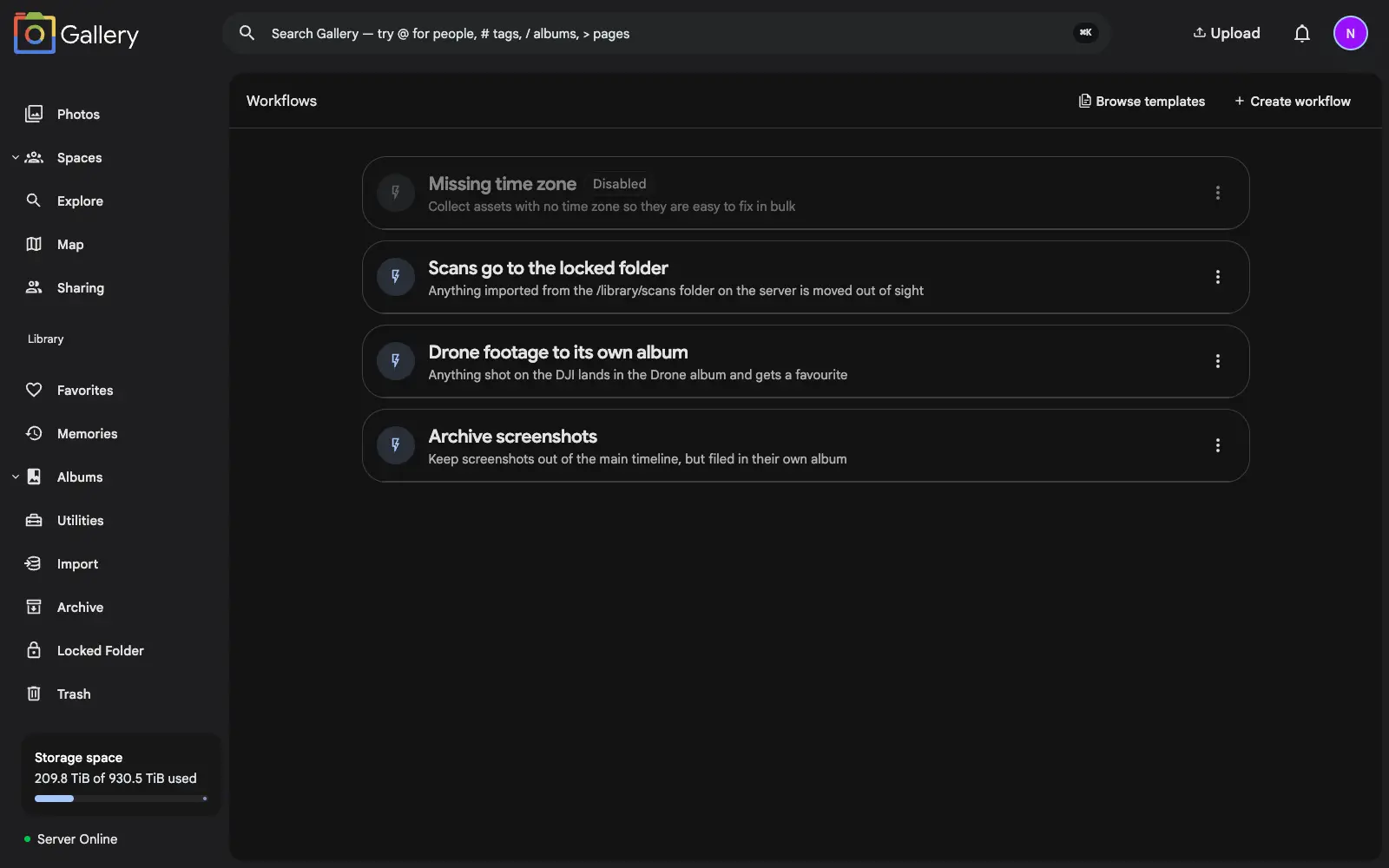
Der Boden bewegt sich. v5.7.0 setzt den gesamten Fork auf die Basis von Immich v3.2.2 — 378 Upstream-Commits unter jede Gallery-Oberfläche gefaltet, der größte Basissprung seit dem Umstieg auf v5.0.0. Das meiste davon ist sichtbar: Memories bekommt im Web eine neu gebaute Seite und zum ersten Mal eine eigene Liste auf deinem Handy — aus der API geliefert, sodass auch die über einen Space geteilten Memories darin stehen, die die Leiste darüber längst zeigt. Die Karte bekommt einen „Fotos in diesem Bereich anzeigen“-Button, der genau das, worauf du geschoben und gezoomt hast, in eine Timeline verwandelt. Workflows führen ein Protokoll pro Lauf, das du öffnen kannst, wenn eine Regel nicht getan hat, was du erwartet hast, und ein Tag kann jetzt der Auslöser eines Workflows sein. Was bewusst nicht mitkommt, ist das neue Gruppen-Sharing von Immich — Shared Spaces erledigt diese Aufgabe bereits, also fliegt dessen Einstellungsoberfläche raus, statt halb verkabelt liegen zu bleiben — und dessen neue Suche, deren Anfrageform an allen vier Dispatch-Punkten abgelehnt wird, weil ihr der Shared-Space-Zweig fehlt. Die Palette bleibt die Suche.
Durchsuche alle gespeicherten Erinnerungen und lege fest, wie lange generierte Erinnerungen in deiner Bibliothek verbleiben.
Karten-Pins in Echtzeit nach Personen, Kamera, Tags und mehr filtern – sowohl für die Gesamtbibliothek als auch innerhalb von Spaces.

Bring deiner Bibliothek bei, sich selbst zu sortieren. Baue Regeln, die greifen, sobald ein Foto ankommt — Screenshots archivieren, Drohnenaufnahmen ins Album, Scans wegsperren.
Gallery's foundation moves from Immich v3.1.0 to v3.2.2: 378 upstream commits replayed underneath, with the fork's own 1,525 rebased on top of them.
Everything else the new base brings is upstream work, documented in Immich's own v3.2.0 release notes plus the v3.2.1 and v3.2.2 patch fixes on top.
The mobile app gets a Memories list of its own, and it reads the paginated memories API instead of the local database.
Asset Tagged joins the trigger list, so applying a tag is now an event a workflow can react to.
Archiving, deleting, locking or restoring a selection on the phone now comes back with an Undo in the snackbar, where before you got a toast that told you what had already happened.
Tag create and edit now print the full path the tag will live at, so you can see that "2024" is about to land under Travel and not at the root.
An API key can now be rotated in place from user settings.
Asset details on mobile now name the person who owns a photo and show their avatar.
The mobile map's bottom sheet now counts what is inside the current view: "No photos in this area", "1 photo", "248 photos".
Add to album now carries the selection size in its title ("Add 37 items to album"), so a bulk add started from a large selection confirms its own scope before you commit it.
Web uploads hash each file with hash-wasm's SHA-1 instead of a pure-JS implementation.
A burst the camera wrote inside the same second used to come back in whatever order Postgres felt like that page, so a sequence could reshuffle between loads.
Immich v3.2.0 introduces cluster groups, a second account-level way for several people to share one library.
Upstream added a second search path that activates on the same endpoints whenever a request carries filter, orderBy or cursor.