IA e automazione
A rebuilt Memories page
Sfoglia tutti i ricordi salvati e stabilisci per quanto tempo i ricordi generati restano nella tua libreria.

Si spostano le fondamenta. La v5.7.0 riporta l’intero fork sulla base Immich v3.2.2 — 378 commit upstream ripiegati sotto ogni superficie di Noodle Gallery, il salto di base più ampio dal passaggio alla v5.0.0. Gran parte di ciò che arriva insieme a essa è visibile: Memories ottiene una pagina ricostruita sul web e, per la prima volta, un elenco tutto suo sul telefono — servito dall’API, così ci sono dentro anche i ricordi condivisi negli Shared Spaces che la corsia soprastante già mostra. La mappa guadagna un pulsante «Mostra le foto in quest’area» che trasforma in timeline qualunque punto tu abbia inquadrato. I Workflows tengono un registro per esecuzione da aprire quando una regola non ha fatto quello che ti aspettavi, e ora anche un tag può essere ciò che ne avvia uno. Ciò che deliberatamente non arriva è la nuova condivisione di gruppo di Immich — quel lavoro lo fanno già gli Shared Spaces, quindi la sua superficie di impostazioni viene rimossa anziché lasciata a metà — e la sua nuova ricerca, la cui forma di richiesta viene respinta in tutti e quattro i punti di dispatch perché non porta con sé alcun ramo per gli Shared Spaces. La palette resta la ricerca.
Sfoglia tutti i ricordi salvati e stabilisci per quanto tempo i ricordi generati restano nella tua libreria.
Filtra i pin della mappa in tempo reale per persone, fotocamera, tag e altro, sia per l'intera libreria sia all'interno degli Space.

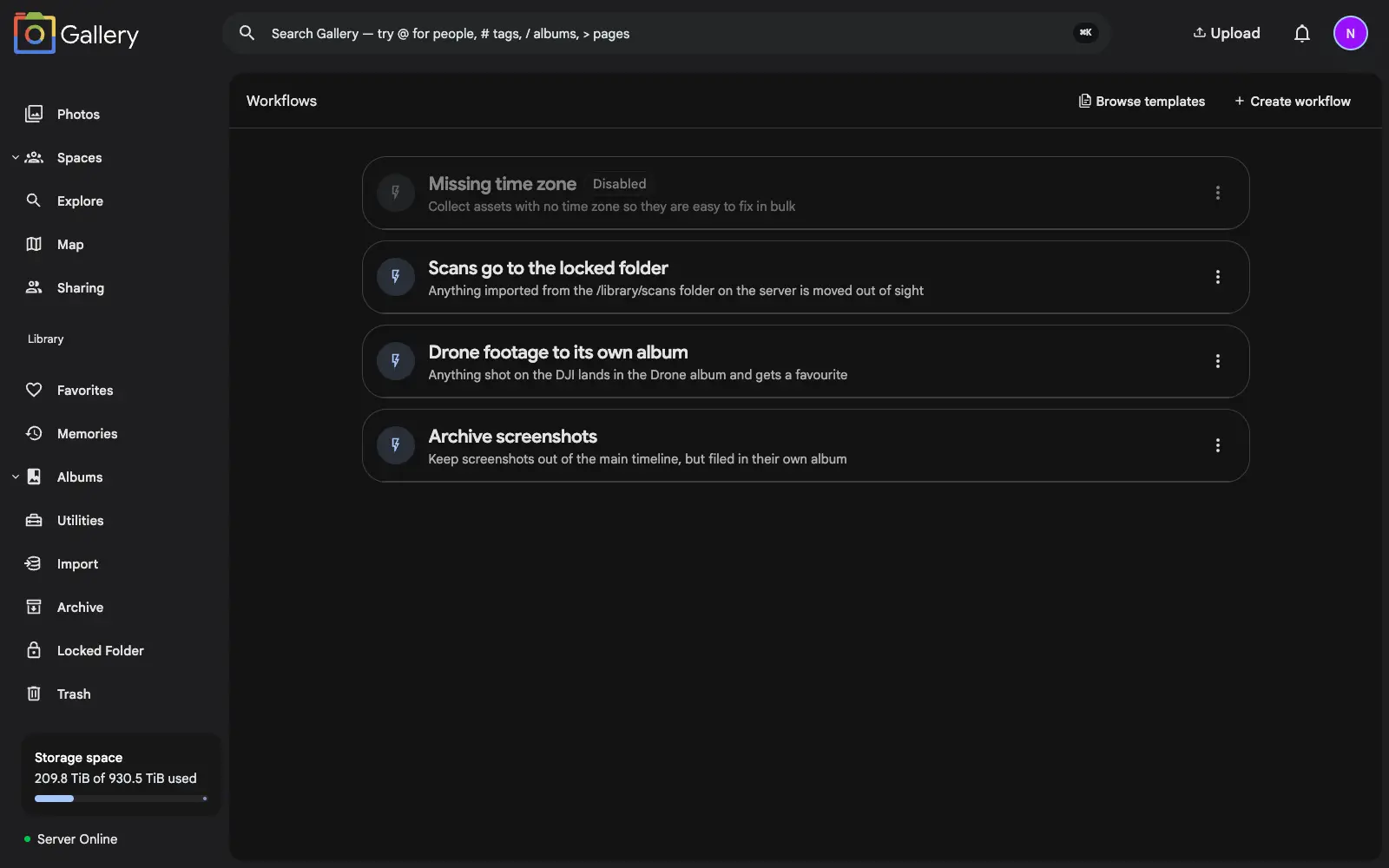
Insegna alla tua libreria a mettersi in ordine da sola. Crea regole che scattano appena arriva una foto — archivia gli screenshot, metti in album le riprese col drone, blocca le scansioni.
Gallery's foundation moves from Immich v3.1.0 to v3.2.2: 378 upstream commits replayed underneath, with the fork's own 1,525 rebased on top of them.
Everything else the new base brings is upstream work, documented in Immich's own v3.2.0 release notes plus the v3.2.1 and v3.2.2 patch fixes on top.
The mobile app gets a Memories list of its own, and it reads the paginated memories API instead of the local database.
Asset Tagged joins the trigger list, so applying a tag is now an event a workflow can react to.
Archiving, deleting, locking or restoring a selection on the phone now comes back with an Undo in the snackbar, where before you got a toast that told you what had already happened.
Tag create and edit now print the full path the tag will live at, so you can see that "2024" is about to land under Travel and not at the root.
An API key can now be rotated in place from user settings.
Asset details on mobile now name the person who owns a photo and show their avatar.
The mobile map's bottom sheet now counts what is inside the current view: "No photos in this area", "1 photo", "248 photos".
Add to album now carries the selection size in its title ("Add 37 items to album"), so a bulk add started from a large selection confirms its own scope before you commit it.
Web uploads hash each file with hash-wasm's SHA-1 instead of a pure-JS implementation.
A burst the camera wrote inside the same second used to come back in whatever order Postgres felt like that page, so a sequence could reshuffle between loads.
Immich v3.2.0 introduces cluster groups, a second account-level way for several people to share one library.
Upstream added a second search path that activates on the same endpoints whenever a request carries filter, orderBy or cursor.